
With all the commotion in the sustainability world related to increasing costs of carbon, organizations are on the hunt for a solution that could help manage the impacts of rising costs of emissions intense production. One particular solution – Internal Carbon Pricing (ICP) – is gaining traction in the market. It is estimated that half of the largest companies in the world are now using ICP as a part of their climate strategy
What exactly is ICP, how and why are companies using it, and how can it
help firms to monetize sustainability?Internal Carbon Price refers to the valuation of carbon within the organization, which is often done through the consideration of carbon-related expenses.
ICP is a way for an organization to calculate its internal cost of carbon emissions, considering carbon-related expenses, presented in a dollar per metric ton of CO2.
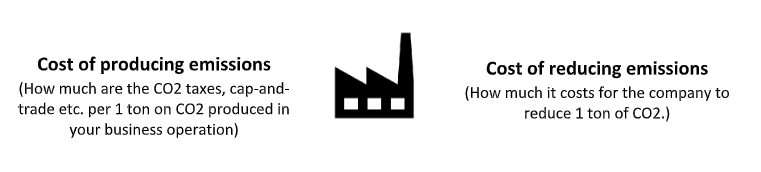
There are two ways of looking at it: the external costs of carbon an organization bears for emitting CO2, such as carbon taxes and cap-and-trade schemes, and the internal abatement cost or the cost of reduction of one ton of CO2, also referred to as implicit pricing. This viewpoint is relevant not only for direct and indirect emissions (Scope 1 and 2) but also for emissions produced in the value chain (Scope 3).
The tool can be used for a variety of business processes, including operations and procurement, and is aimed at supporting organizations with their decarbonization objectives. Unlike external systems such as carbon taxes and cap-and-trade programs initiated by governments, this is a voluntary approach that companies may pursue to better manage their carbon footprints. There is even some evidence that implementing an ICP in a company helps reduce carbon emissions per revenue by an impressive 26.2% in comparison to those firms who do not use the tool, as well as increasing returns on assets.
Overall, several ICP approaches exist, all with different aims, benefits, and drawbacks. The most popular approaches are shadow pricing, internal carbon fees, and implicit pricing. Also referred to as proxy prices, shadow prices place a theoretical value on carbon emissions, functioning as a risk assessment tool for the organization to assess the carbon costs associated with specific decisions. With a shadow price mechanism, an ICP can be used in investment calculations, however, no actual financial flows are generated, meaning this is a purely theoretical approach.
The goal is to account for the cost of carbon in a company’s strategy and the Return on Investment (ROI), and to shift investments into long-term decarbonization. This approach helps to prepare for the impacts of emerging regulations as organizations take into consideration the expected future costs of carbon in their decisions. This methodology is most used in Capital Expenditure (CAPEX) decisions, however, can be applied to different activities and at various price levels. It can also be used in making value chain decisions, for example by including shadow pricing as a supplier selection criterion.
If companies are looking for a more cost-driven approach, setting an internal carbon fee or carbon tax may be another suitable option. An Internal Carbon Fee, working like a carbon tax, functions by charging departments, units, or suppliers directly for their associated GHG emissions. A derivative of this approach is setting up an internal cap-and-trade system and issuing company emissions credits, like how a government-based cap-and-trade functions. Regardless of which variation of the approach is used, the idea is that the department or functions will reduce their
emissions to avoid paying the internal carbon fee.
Compared to a shadow price and carbon fee which in most cases mimic external regulations and help companies manage existing and expected CO2 costs, an implicit price represents the real cost of carbon reduction within the company – unrelated to the external costs of CO2 on the market. It is calculated based on the companies’ expenditures for emission abatement projects. Where projects have not yet been executed, investment costs and energy savings can be estimated to derive a $/ton of abatement value. This approach is more geared towards improving the decision-making process and including emissions as one of the factors against which initiatives are being evaluated.
As any other business decision, ICP needs to make sense from a financial perspective. So, how can an ICP help your firm monetize sustainability? Especially in the context of the new Carbon Border Adjustment Mechanism coming into force, ICP could be a particularly useful tool for getting a handle on the CO2 costs for the organization. With this EU regulation, importers of carbon-intensive goods into the EU will have to purchase CO2 digital certificates from 2026 to offset the higher carbon intensity production abroad.
As more companies will see direct CO2 costs on their balance sheet, the ability to better understand and manage the financial aspect of emissions associated with the firms’ business activities could be a game changer in their ability to monetize on sustainability.
The aim is for organizations to get a grasp of the final, real financial implication numbers on the balance sheet associated with carbon. Emphasizing the words “true cost”, it’s important to be aware of carbon costs already included in the costs of commodities you purchase to avoid double counting or exaggerating the true costs of carbon to the company. Therefore, defining a clear ICP approach, whether shadow pricing, carbon fees or any other approach, could be an insightful exercise for companies to understand the drivers of external carbon costs relevant to them.
Emphasizing the words “true cost”, it’s important to be aware of carbon costs already included in the costs of commodities you purchase to avoid double counting or exaggerating the true costs of carbon to the company.
Looking at it from the side of internal initiatives, ensuring monetization of sustainability means investing where it truly makes sense, not only from a carbon reduction perspective but also from a financial perspective. Sustainability funds are often limited, and the power of a dollar is different in various parts of the globe, therefore including ICP as a metric in project evaluations could be particularly beneficial for international companies. In a company with multiple sites, different locations will likely have various maturity levels of energy efficiency, carbon regulation, and other factors influencing the costs and benefits of emissions abatement. Particularly for companies operating in vastly different regions, ICP could help a firm with prioritization of investment into the most attractive locations for emissions abatement activities.
Another and probably most attractive aspect of ICP is that it functions as a translator of CO2 emissions into the common language of finance – the dollar. As a metric, it becomes much easier for other departments to get a feel for CO2 emissions and compare it side by side with other financial metrics.
At the end of the day, having a better feel and understanding for the drivers of carbon costs (both from external carbon pricing schemes and internal activities) will become a crucial aspect in a company’s ability to thrive in the ever-changing sustainability landscape. Whether this glimpse of Internal Carbon Pricing left you looking to explore this tool in more detail or searching for another way to manage your CO2 costs, it is clear that companies need to be presented with an arsenal of tools that makes sustainability a tangible topic which can be integrated into all business decisions.
 julianitz.com
Leave a comment